Care as methodology
On being a researcher in the strategy industry. And reflections on how care becomes a valuable scarcity in a world where speed and ego erode the sincerity of knowledge.

As an academic who has thrown herself into the strategy industry, I have begun to feel a particular sense of discomfort in carrying the title researcher. Most people immediately assume that the shame is tied to its perceived “stiffness.” But mine resembles something far more disorienting: it’s the sense that the word no longer refers to the meaning I had once valued. The discomfort lies in the gradual erosion of substance: that in this industry, research feels increasingly indistinguishable from the circulation of pre-existing findings, but only lightly rearticulated with fancier words, more efficiently packaged (i.e., diluted down and stripped out of context), and prematurely stabilised into something that resembles “insights” without having undergone the labour that insight demands.
And if that’s the meaning this title holds, I’m embarrassed.
I force myself to observe very closely and really search for inspiration in what has accumulated across my inbox and professional peripheries—the trend reports, foresight decks, annual outlooks, you name it—and they’ve been less a body of work than a repetition of gestures. Some sort of choreography of “recognition” masquerading as “discovery.”' It’s not that they’re necessarily incorrect—which is precisely what makes them so difficult to contest—but they rarely feel as though they have arrived at anything that required genuine interrogation. What the industry calls “insight” often collapses into a surface-level behavioural observation seen from a distance—one that is immediately legible and therefore rarely questioned. But should visibility itself be a sufficient proof of understanding? I don’t believe so.
And I find myself skimming these reports out of a certain flatness of encounter because nothing in the work resists me long enough to require that I stay. Academic work may feel boring because it’s difficult to grasp, but this is a worse kind of boredom: polished language as a wow factor without substance underneath (yes, it’s the same kind of critique that I have against AI-generated output, to be completely honest).
We’re pushed to produce, with increasing sophistication, what I can only describe—perhaps unfairly, but not inaccurately—as a form of “insight laundering”: the continuous reprocessing of existing observations into newly articulated claims, where the appearance of novelty is sustained not by knowledge contribution, but by repackaging. This would explain why the industry has started to throw the word “taste” so carelessly as an edge, just like the tech companies did with “disruption” in the 2010s—replacing rigour with cultural capital, making preference look like insight without actually advancing understanding. And to me, that sounds much less like an inspiration than a projection of denied fear, a very lazy coping mechanism—a solution that shows utter disrespect to the labour of intent, sincerity, and discernment.
And I’m not saying that nothing is being produced, but that what is produced rarely exceeds the conditions from which it was derived.
And perhaps what is most striking isn’t simply that the work remains at a behavioural level, but most of the time it’s at the level of behaviour that’s performed. Even when it gestures toward something deeper—like shifting desires, fears, or beliefs—it retreats before those categories are allowed to destabilise the initial frame. The why is invoked, but never acknowledged, let alone endured. And I understand why: to remain with the why is to enter into a kind of slowness that is structurally inconvenient—a form of thinking that resists the “efficiency” and deliverables that organise the industry itself.
But if that’s the case, then why not let go of the word research entirely? Why cling to the name without the responsibility of protecting its labour? If it’s about rewriting, why not call it what it is? To earn the honour of the title, that labour is deeply necessary.
Because what comes with the weakening of insight is a reconfiguration of how the world itself is perceived.
I’m sure we’ve all heard the commentaries on how the world is becoming culturally flat, repetitive, and predictable. I keep wondering whether it is true that the culture is flattening, or whether our method is? Is the culture really static and unmoving, or are we just too lazy to dig its complexity more deeply? Because whenever I turn inward, I can sense shifting beliefs and fears—alive, layered, and textured—so why, then, does the report render them in such stark black and white?
Because the world isn’t becoming simpler, are you kidding me? The world is now more complex than ever. We’re the ones becoming more efficient at avoiding its complexity.
This is the point at which the discomfort ceases to be passive. If this is what “research” has become in the industry, then to continue participating in it without interrogation begins to feel less like contribution and more like complicity. It feels like letting go of sincerity and integrity, and ignoring any forms of accountability toward the knowledge we pass on to prominent agents of change—in this case, brands.
And so the question that has occupied me, increasingly, is not necessarily how to produce better outputs. I’m questioning the integrity that has a deep and direct impact on quality: how might we recover a different orientation toward the act of inquiry itself?
And I wonder… what would it mean (not rhetorically, but structurally) to introduce care into methodology—as the scarcest value in today’s world?
When I say care, I don’t think of it as a moral gesture, but as a discipline of attention. Or the art of noticing. As a way of deciding what’s allowed to remain difficult, what is refused a premature closure, and what’s taken seriously enough to be followed and wrestled with.
Care as methodology in three pockets of my reflections below.
I. Care in how we see
To care is, first, to refuse the reduction of differences into coherence simply because coherence is more digestible to communicate. It’s to remain with what doesn’t align and to treat contradiction as a signal that, perhaps, our lens of interpretation may actually be insufficient. The outlier, in this sense, ceases to be a contradiction to be explained away, and becomes instead a site of epistemic pressure—a point at which the limits of our current understanding are made visible. And this has consequences for what we prioritise too: not just interrogating whether we need to expand the scale, but also deepening our interpretation and refining its meaning. Care, in this sense, allows us to ask, not simply what is happening, but what must be true for this to be happening at all.
But care cannot remain at the level of perception.
II. Care for knowledge
Very little of what we encounter is new, and I think any honest researcher would acknowledge that. Most inquiry is already situated within a lineage of thought. Academia, for all its limitations, insists on positioning claims within existing bodies of work and deliberately making visible the conversations that precede them.
The strategy industry, by contrast, often operates as though each project begins from a blank slate—as though knowledge must be continually re-authored for it to be owned. If you ask why, my guess is that there’s an absence of accountability with an excess of unregulated ego. It becomes a competition over who pioneers what, who gets to claim something “new”—and not what makes something unquestionable, undoubtable, accountable; not what makes something ethical; not what sustains impact over time.
What this produces is not simply a matter of redundancy, but also a form of intellectual fragility: hypotheses may appear robust only because they’re designed to be some shiny hot takes, yet remain untested and unexamined in relation to alternative interpretations. And in a context where tools (particularly AI) can so easily generate and validate supporting evidence, the risk isn’t that we’ll lack proof to back them up, but that we’ll become less attentive to what has been excluded in the process of producing it.
Care, then, requires not just the ability to substantiate a claim, but the discipline to interrogate its limits: to ask what would disprove it, what it fails to account for, and what assumptions it relies upon. And yet, even this remains incomplete if care doesn’t extend to the question of who is permitted to produce meaning at all.
III. Care for our positionality
Today, even in its most progressive articulations, the research process sadly remains fundamentally extractive. We speak to people, gather their experiences, document their realities, but interpretation remains centralised. Meaning is still authored elsewhere. And while this is often justified through the language of expertise, it raises a more difficult question: what forms of knowledge are systematically lost when lived experience is treated as input rather than co-authorship?
Other disciplines—like sociology, anthropology, or public policy—have long grappled with this question, often contemplating the redistribution of authority. And perhaps this is where brands and the industry need to pause. Because when we take our brands seriously, we know that accuracy isn’t only desired, but it’s also required. We know that understanding can’t be constructed without those we claim to understand. The question, then, isn’t whether we should involve communities, but what becomes possible when we do so with intention: What would shift in the integrity of our insights? What does it cost us, but what does it return in truth? And ultimately, what does it demand of how we define impact, and not just for the brand, but for the people it claims to serve?
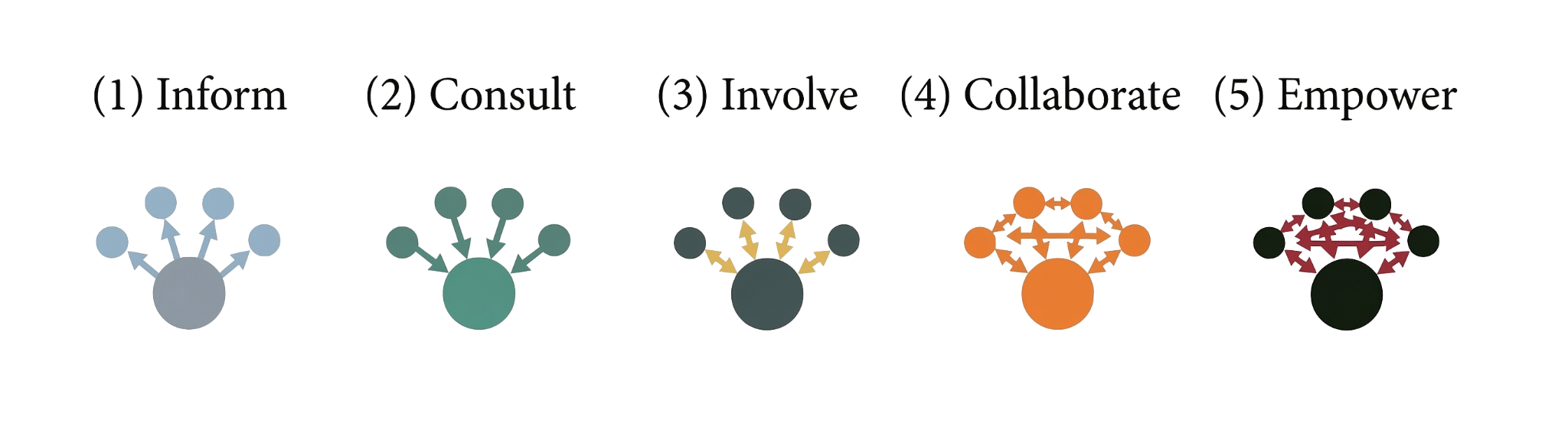
Borrowing from the school of public policy, IAP2 Spectrum of Public Participation (Fig. 1) is one of the frameworks critical to methodology.
Brands today operate as cultural agents in ways not entirely different to political institutions: they shape meaning, influence behaviour, and participate in the trajectory of systemic change. And like politics, they depend on public legitimacy (or, in brand lingo, “brand loyalty”). Yet this raises a dissonance that’s difficult to ignore: why are brands so invested in loyalty yet remain comparatively disengaged from the very people they rely upon?
The movement from (1) to (5) is not simply procedural. It reflects a shift in who is allowed to determine what counts as “knowledge,” and whose interpretation holds legitimacy.
At present, brands understand that participation is fundamental, but only to the extent that it requires access to experience. There remains a persistent top-down orientation: people provide information, but interpretation of intent, need, and solution remains the domain of the “researchers.” It’s subtle, but it’s deeply consequential. Because it reveals that what’s being protected isn’t necessarily accuracy, but authority. And it’s exploitative. Extractive. And so the unavoidable question is: what knowledge is excluded when we assume that our expertise is inherently more credible than how people make sense and make meaning out of it?
Brands’ movement from (1) informing to now exercising the stage of (2) consulting illustrates this clearly. Consultation appears, on the surface, to be the most “objective” form of insight: clean, structured, and distanced. We engage in FGDs, IDIs, and ethnographies, and throw the so-called “voice of the consumers” on our decks. There’s a clear hierarchy: culture as object, people as data, strategists as interpreters, and brands as decision-makers. But even here, neutrality is fictional! When we care about our positionality, “insight” is already filtered through an institutional lens, shaped by what’s considered relevant, legible, and actionable. Yes, brands have to move within the limitations that only we will know, but pre-limiting the vast possibilities of our insights by our limitations is, perhaps, the poorest way to use our biases to our benefit.
The worst risk posed to us is encountering the unknowns of which existence we don’t even know.
So what would it mean to move beyond this?
What would happen if we began to (3) involve and to think with? In this mode, meaning-making becomes shared, and strategists relinquish monopoly over interpretation. There are iterative loops of validation that are incredibly valuable: Does this reflect you? Does this hold? Of course, insights are less “clean” and polished, but more accountable. To move further into (4) collaboration is more confronting still. Because here, control is redistributed. Strategy is no longer authored solely by the brands, but co-constructed with those whose realities it seeks to represent. This means community members become ongoing partners rather than one-off participants, and cultural insiders shape narratives in their own language.
The discomfort is inevitable, but perhaps necessarily so, because meaningful insights—if they were to be more than surface articulation, and better, groundbreaking—should unsettle us to some degree. It should resist immediate closure.
And beyond (4) collaboration lies the question of (5) empowerment as structure. What would it mean for engagement to move from extraction to circulation and to redistribution? Practically, this would require a shift that is both simple and profound: to stop ending at data collection, and begin involving people in interpretation; to stop presenting insights as fixed truths, and instead treat them as propositions to be negotiated; to build long-term relationships with communities rather than one-off engagements; to compensate not only for time, but for intellectual contribution; and to establish feedback loops that make visible what has changed as a result of participation.
The implications challenge not only methodology, but also identity. I’m deeply pondering on what it means to be a “researcher” or “strategist” today, but also how that role might evolve when there’s a ripe opportunity for authorship to become much less singular. Or when meaning-making is no longer fully controllable?
To dismiss these questions is shortsighted.
Much of what we call cultural insight today isn’t failing because it lacks empathy or inspiration. Rather, here’s the problem that gets me awake at night: cultural insight seeks proximity to culture, but resists any accountability to it.
If care were to be taken seriously as methodology, what would it mean for insight to be accountable not just to accuracy, but to the very people it claims to represent—and who, then, would have the authority to hold it to account? What would sincerity in research actually demand of us, if it required not better articulation, but a willingness to confront where our interpretations preserve our authority more than they reflect reality? And if care were not a posture but a method, how would we make sense of our role as “researchers” when meaning is not to be “stabilised” but rather sense-made?